Las Míticas Toy Fair de Kenner (1981-1985) – Parte II
Lo que se revisa en estos artículos es un verdadero tesoro para cualquier coleccionista de Star Wars. Son algunas de las únicas imágenes que existen de los showrooms de Kenner en las Ferias de Juguetes de principios de los 80, con fotografías pertenecientes a las colecciones de Todd Chamberlain, Chris Georgoulias, Ron Salvatore, John Kellerman, Gus López y Will Grief, todos del gran sitio de Gus López, The Star Wars Collectors Archive.
1981: La Expansión de Kenner y los Dioramas Épicos de Star Wars
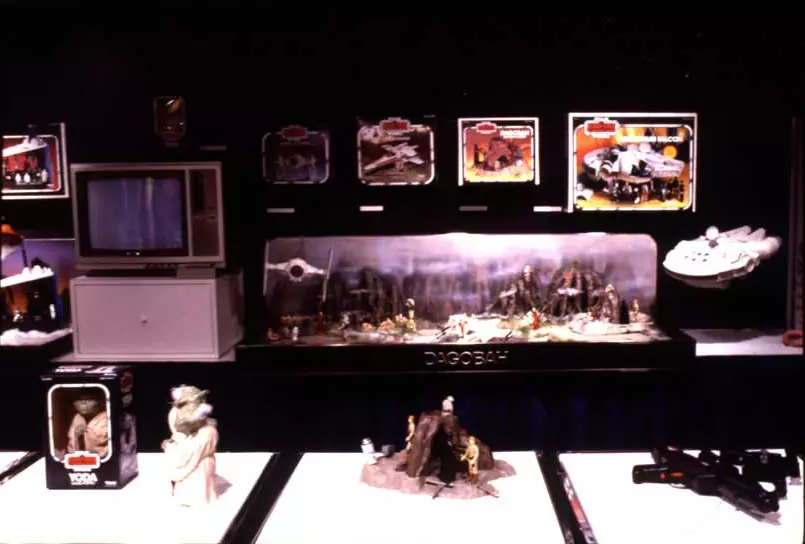
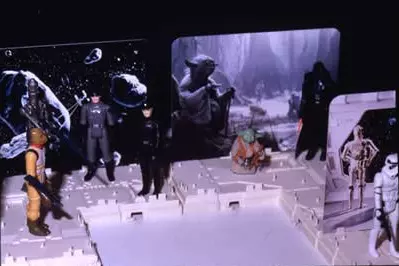
Para la Toy Fair de 1981, Kenner apostó fuerte por la inmersión en el universo Star Wars, montando tres dioramas espectaculares inspirados en El Imperio Contraataca:
- Dagobah: la tierra de Yoda y los entrenamientos Jedi de Luke.
- Hoth: la legendaria batalla entre la Alianza Rebelde y el Imperio.
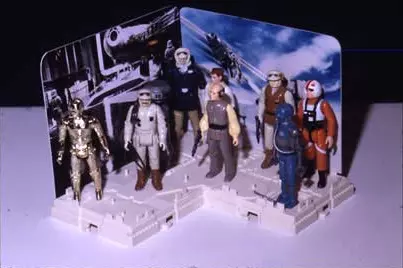
- Bespin: la ciudad flotante de Lando y el icónico duelo entre Vader y Luke.
Estos dioramas no sólo mostraban las figuras y vehículos en su hábitat natural, sino que también ofrecían un nivel de detalle nunca antes visto en una Toy Fair, con efectos de niebla, texturas realistas y fondos pintados a mano.
Dagobah: El Mundo de Yoda en Miniatura
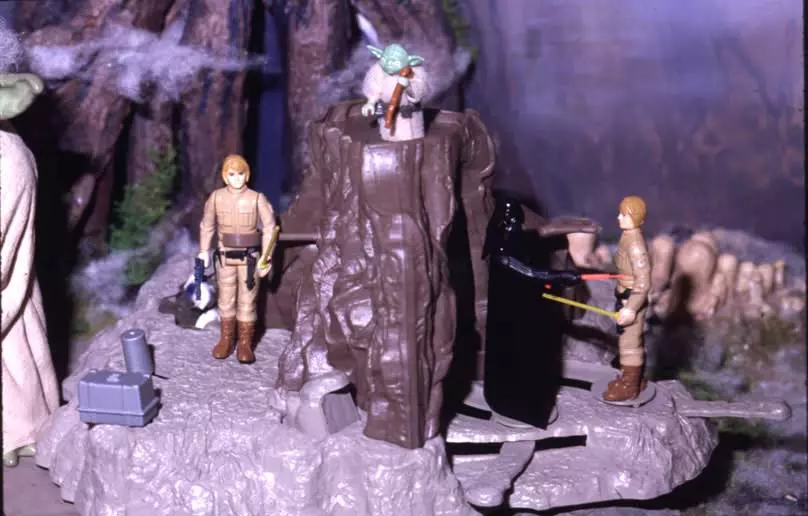
Kenner no escatimó en detalles para recrear Dagobah en su showroom. Gracias a un fondo pintado con árboles retorcidos y niebla artificial hecha con espuma o algodón, el Dagobah Playset se robó la atención, con sus raíces tridimensionales y su función de levitación para entrenar a Luke con la Fuerza. Al diorama se incorporaron el TIE Fighter y el X-Wing. La caja del X-Wing tenía una caja con una nueva imagen basada en Dagobah.
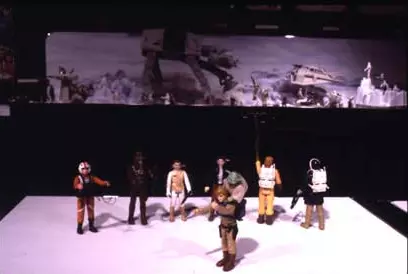
Hoth: La Guerra en el Gélido Campo de Batalla
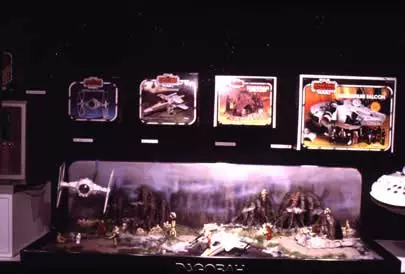
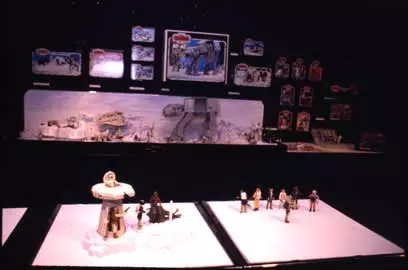
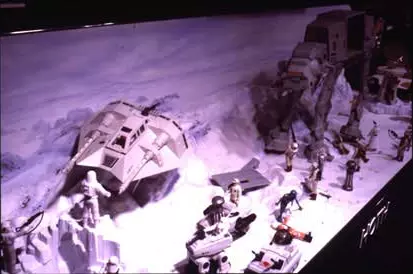
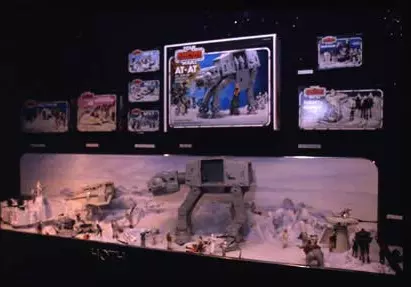
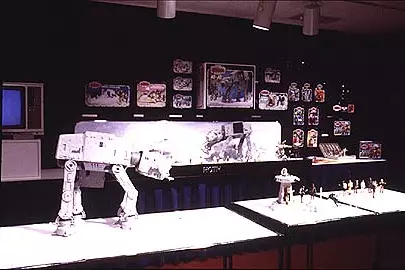
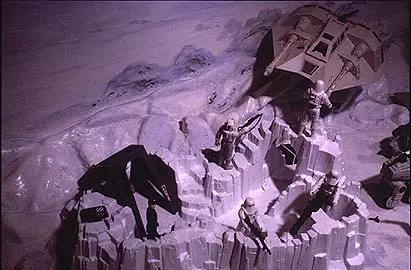
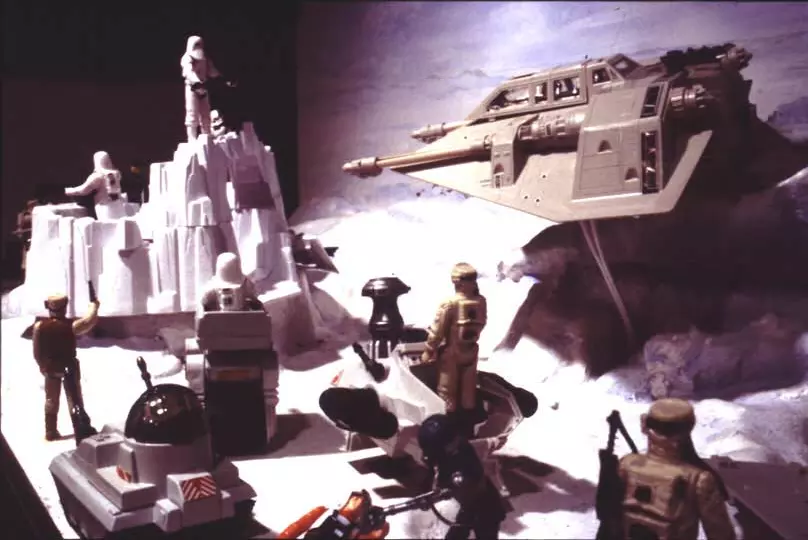
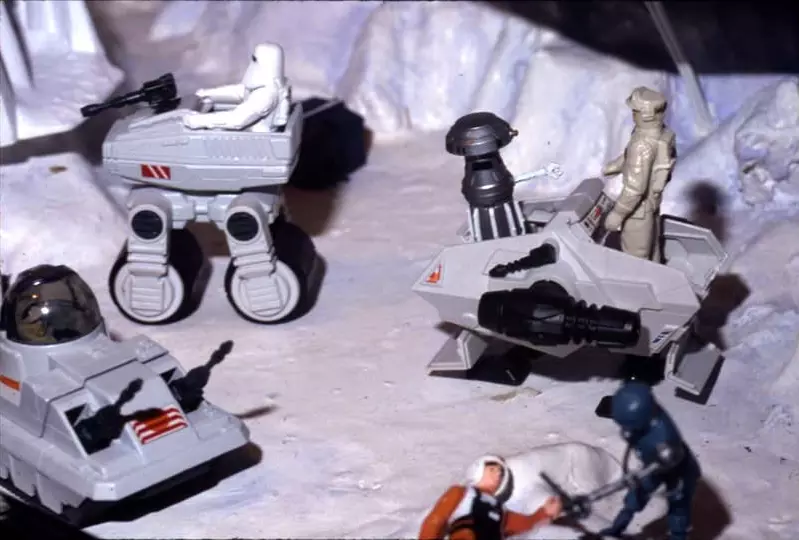
El diorama de Hoth fue uno de los más impresionantes del showroom, con una enorme área dedicada a la batalla más famosa de El Imperio Contraataca (y de la saga), que se mostraba con un fondo nevado pintado a mano y efectos de “nieve” aplicados manualmente y que contaba con los siguientes juguetes:
- Imperial Attack Base
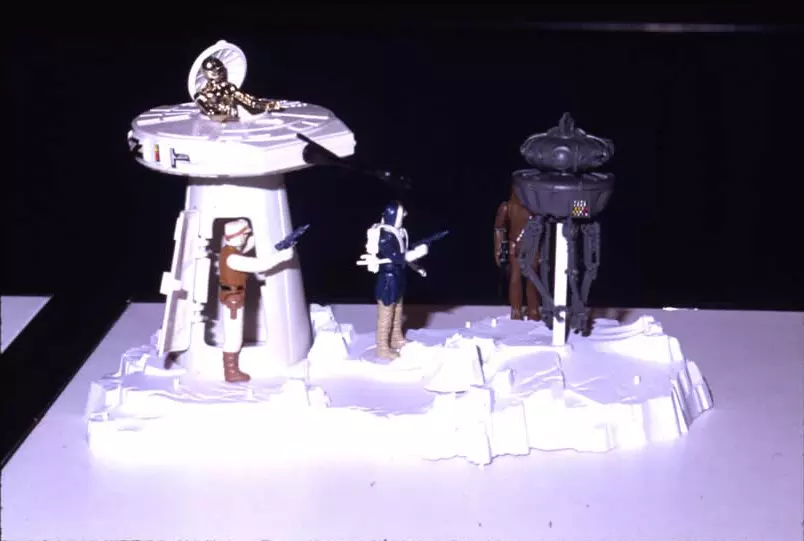
- Turret and Probot Playset
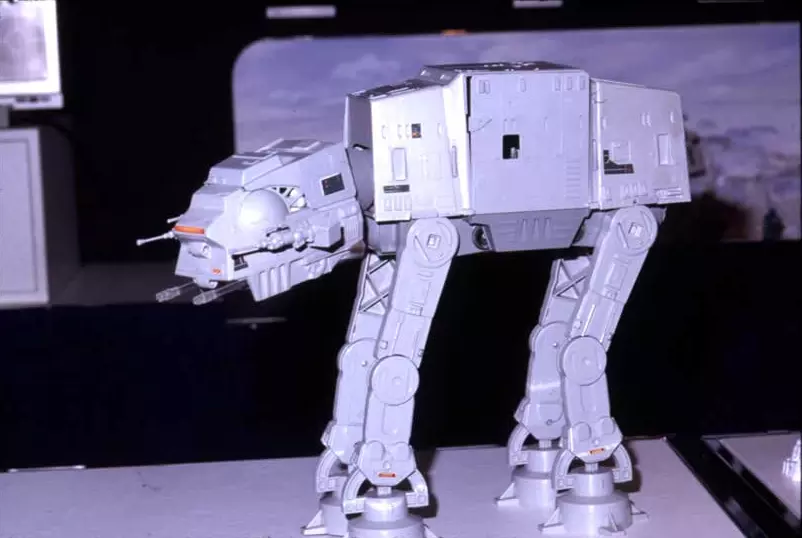
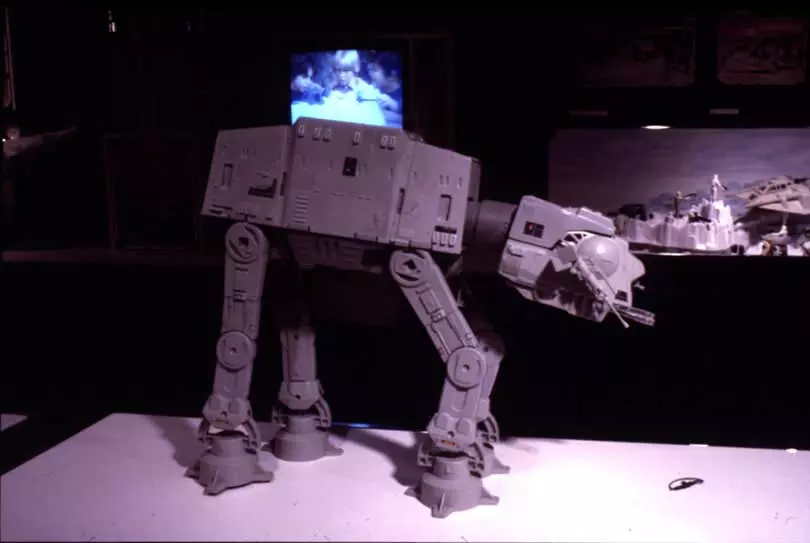
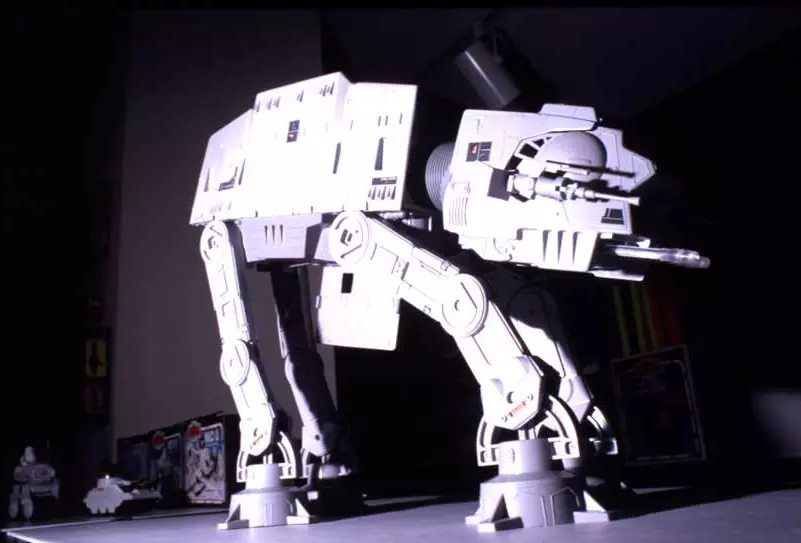
- AT-AT Walker
- Snowspeeder
- Mini-Rigs – Varias versiones de esta novedad, mostrando cómo Kenner expandía el universo de Star Wars con vehículos inéditos.
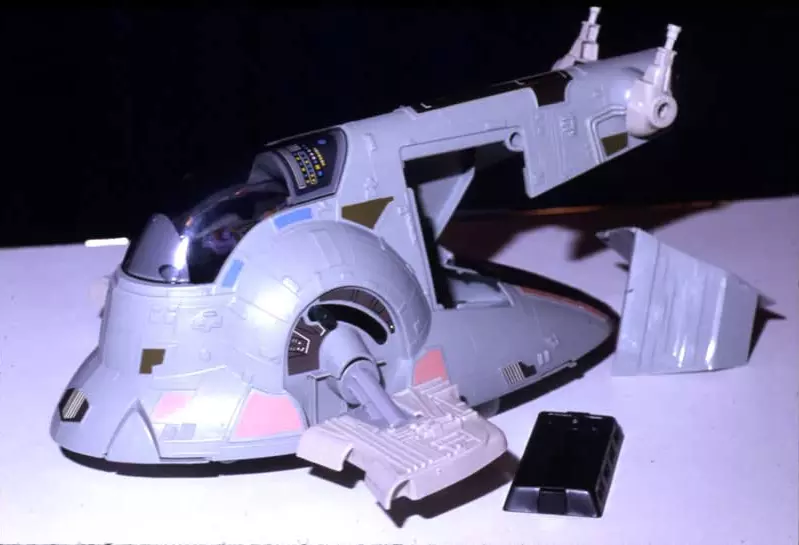
Bespin: La Ciudad en las Nubes y la Slave I
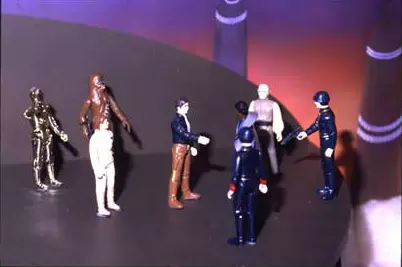
El diorama de Bespin, aunque menos documentado que los otros dos, demostró el nivel de detalle de Kenner al recrear escenas icónicas. Pareciera ser que está menos documentado porque se aprecia un poco màs pobre comparativamente.
La llegada a Cloud City
- La plataforma de aterrizaje donde Lando recibe a Han y Leia estaba meticulosamente representada.
- Curiosamente, en vez de usar la figura de Leia en su vestido de Bespin, el diseñador optó por la versión con el traje de Hoth, un detalle que reflejaba una gran fidelidad a la cronología de la película. Recordemos que la figura de Leia Bespin se lanzó en la cuarta ola, mientras que Leia Hoth en la sexta ola.
- Un truco visual extendía la plataforma mediante una pintura en el fondo, dándole profundidad a la escena. Método muy utilizado en las películas.
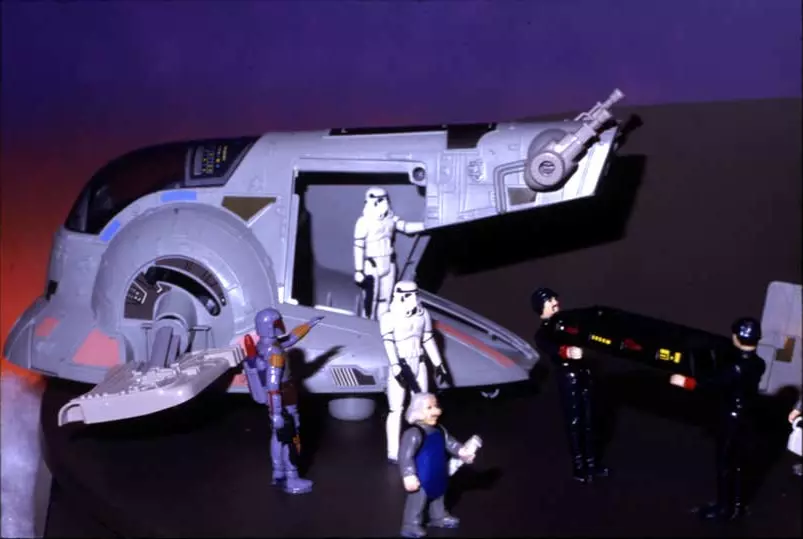
Slave I y Boba Fett
- La Slave I se exhibía rodeada de figuras, creando una escena digna de la captura de Han Solo.
- Al igual que en el anterior, los efectos de profundidad en el fondo pintado agregaban realismo a la ciudad flotante.
El Diorama de Figuras de Acción y las Promociones Mail-Away
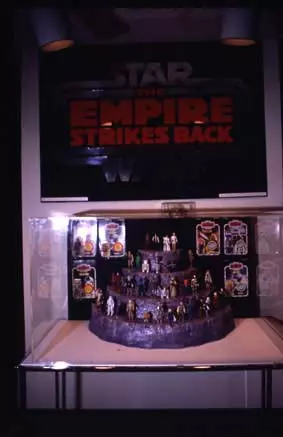
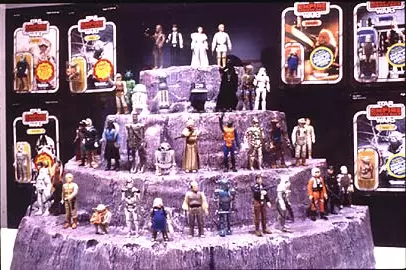
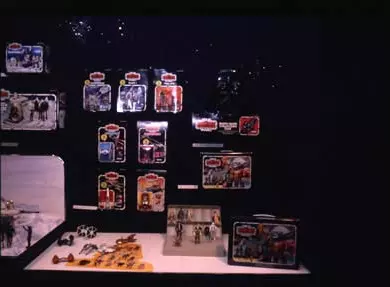
Como en años anteriores, Kenner presentó sus figuras en una exhibición especial, esta vez con una montaña de exhibición atrás de un vidrio rodeada de figuras en blister con las ofertas mail-away de 1981:
- Display Arena – 4 soportes exclusivos para colocar las figuras con diferentes motivos asociados a las películas.
- Survival Kit – El accesorio mail-away del año, que incluía mochilas, armas y herramientas para complementar las figuras.
El logotipo de Empire Strikes Back flotaba sobre el display, reforzando la identidad de la línea. Ambas promociones se encontraban también en exhibición.
Vehículos, Accesorios y Curiosidades del Showroom
Entre otras exhibiciones destacadas, se encuentran:
- Slave I – Aunque estaba en el diorama de Bespin, también tenía su propio display.
- El legendario AT-AT – También tenía su exhibición propia con comerciales en televisión detrás de este.
- Turret & Probot Playset – Con C-3PO, que parece haber tomado un blaster de la torreta (¡qué rebelde!).
- Die-Cast Vehicles – Mostrados junto a los case de Darth Vader y estuches de vinilo del Imperio.
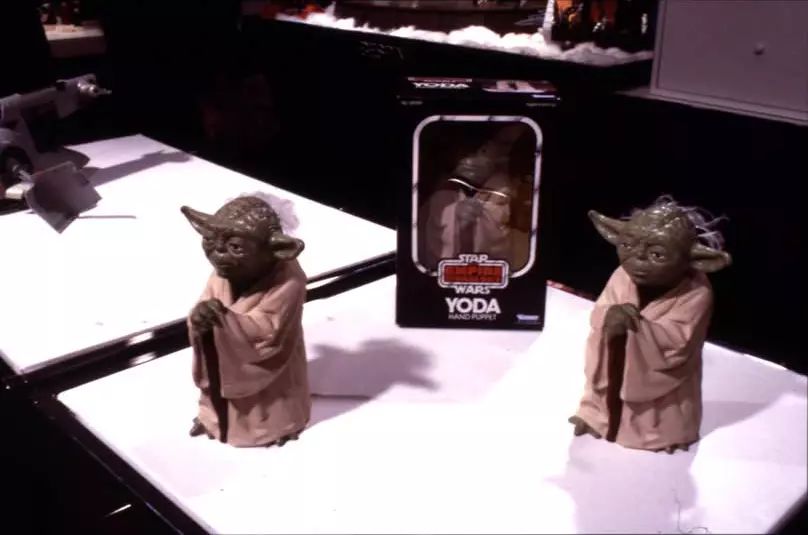
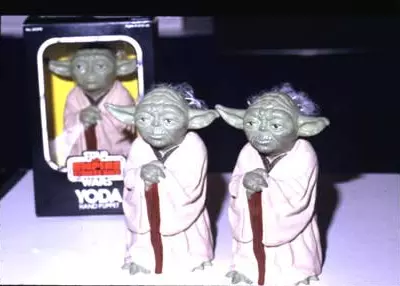
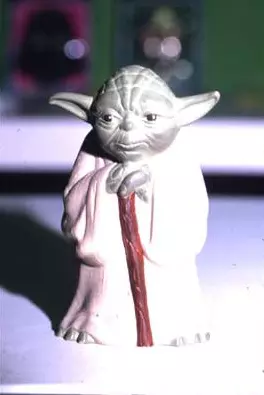
- Yoda Handpuppet – Un títere de vinilo que permitía a los niños dar vida al viejo maestro Jedi.
- El Yoda Jedi Master “Magic 8-Ball” – Un juguete adivinador basado en Yoda, una rareza dentro de la línea Star Wars.
- El “Star Wars is Forever” Retail Display – Un eslogan que Kenner utilizaría a lo largo de los años para reforzar el impacto de la franquicia (Y no se equivocaron).
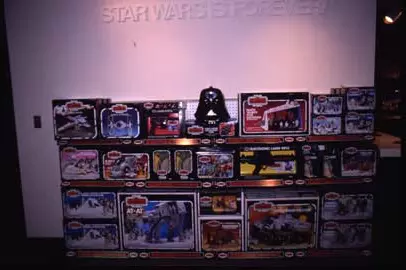
Con dioramas impresionantes, una oferta cada vez más variada y una estrategia comercial más agresiva, Kenner dejó claro en la Toy Fair de 1981 que Star Wars ya no era sólo una línea de juguetes, sino un universo entero que los niños podían explorar y coleccionar.
Para los coleccionistas de hoy, esta exhibición representa un hito en la evolución de la franquicia, donde Kenner dejó de simplemente vender figuras y empezó a recrear la galaxia en cada detalle.
Y tú, si hubieras estado ahí, qué pieza te habrías llevado sin dudarlo?
1982: Aparece otro grande en escena
En 1982, el mercado de juguetes experimentó cambios significativos con la introducción de nuevas líneas que impactaron la popularidad de productos existentes como los juguetes de Star Wars de Kenner. En el sitio Battle Ram Blog se menciona que la línea de juguetes Masters of the Universe (MOTU) de Mattel se presentó al público por primera vez el 17 de febrero de 1982 durante la Toy Fair de Nueva York. Este evento fue significativo, ya que marcó el debut oficial de He-Man y su universo, introduciendo a los personajes y productos que conformarían la línea. El blog destaca que, aunque algunos celebran el 12 de octubre de 1982 como el aniversario de He-Man, la evidencia sugiere que la línea MOTU ya estaba disponible en tiendas para mayo de 1982, con una oferta de reembolso en los primeros minicómics que indica que las figuras podrían haber estado en tiendas desde el 1 de marzo de 1982.
MOTU rápidamente ganó popularidad y se convirtió en un competidor destacado en el mercado de juguetes de acción. La introducción de He-Man representó una competencia directa para las líneas de juguetes establecidas, incluyendo la de Star Wars de Kenner. Aunque los juguetes de Star Wars continuaron siendo populares, la aparición de nuevas líneas exitosas como He-Man diversificó las opciones disponibles para los consumidores y pudo haber afectado la cuota de mercado de Star Wars en ese período.

En el artículo de prensa del Austin American-Statesman, fechado el 1 de diciembre de 1982 se menciona la guerra de los juguetes entre Kenner, Hasbro y Mattel, describiéndola como un conflicto recurrente en la industria del juguete, con intensificación en la temporada de compras navideñas. En particular, se señala que las batallas entre estas compañías se reactivaron alrededor del Día de Acción de Gracias, con una estrategia agresiva de publicidad dirigida a niños de 5 a 11 años. Por su lado, Kenner es destacado como el productor de las figuras de acción de Star Wars, incluyendo personajes como R2-D2, Luke Skywalker, Leia Organa, Darth Vader y Yoda. Esto es curioso ya que dicho año, la línea de figuras de acción se amplió con personajes adicionales, incluyendo versiones actualizadas de R2-D2 (con Sensorscope) y C-3PO (con extremidades desmontables), así como nuevas incorporaciones como Luke Skywalker con equipo de batalla en Hoth, el Comandante AT-AT, el piloto del Cloud Car de doble cápsula, el guardia de seguridad de Bespin, junto con 4-LOM, Zuckuss, y el piloto TIE Fighter imperial.
En dicho artículo se menciona también que los productos de Star Wars están entre los cinco juguetes más vendidos, junto con otras líneas populares de la época como Strawberry Shortcake (Kenner), Barbie (Mattel), E.T. (varios fabricantes) y Masters of the Universe (Mattel). Por último, se hace mención a He-Man y los Amos del Universo como un competidor emergente sugiriendo que un “plagio” de la idea de Star Wars, pero combinado con la fantasía de Dungeons & Dragons.
A pesar de agregar artículos interesantes a la colección, el 82 fue tal vez para Kenner un año medio flojo en cuanto a nuevas ofertas atrayentes que hicieran que su participación en la Toy Fair de ese año fuera menor, dando protagonismo a nuevos competidores.
1983: Conviviendo con ET
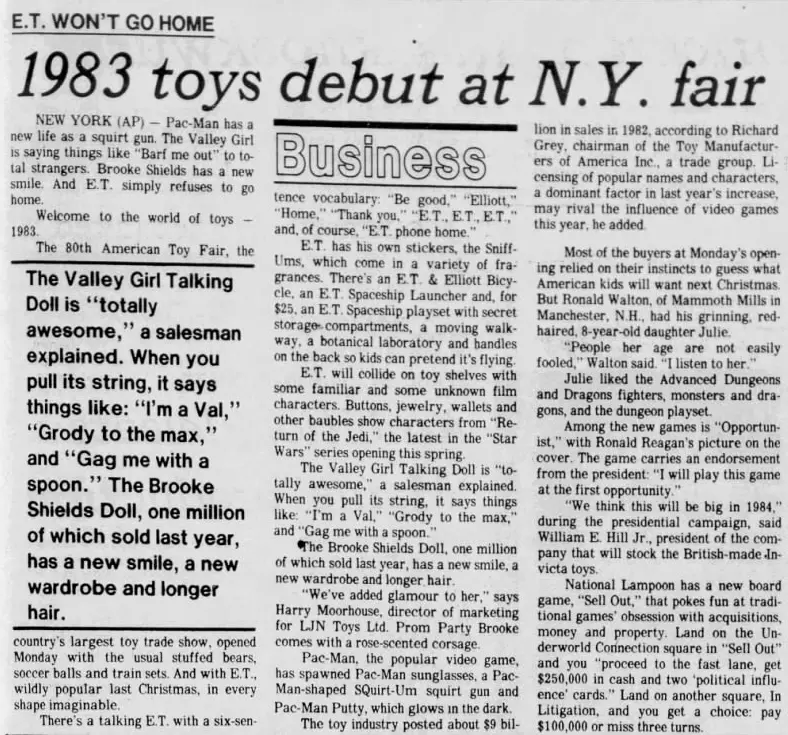
A pesar del impacto de E.T., el Extraterrestre en la industria del entretenimiento y su éxito en el mercado de juguetes con cientos de productos licenciados, Star Wars continuó presente en la escena, aunque con ventas más modestas en comparación con años anteriores. Mientras los productos de E.T., como los muñecos de peluche de Kamar International, dominaban las ventas navideñas, la franquicia de Star Wars, impulsada por Kenner, mantenía su lugar en la Toy Fair pero sin el furor de años previos.
La llegada de E.T. coincidió con un cambio en las tendencias del mercado de juguetes, donde los productos con licencias fuertes—como Strawberry Shortcake y Los Pitufos—se mantenían sólidos, pero las ventas de Star Wars reflejaban un desgaste natural tras años de dominio. Este cambio también se vio influenciado por el auge de los videojuegos, especialmente con la popularidad creciente de Atari y los sistemas de competencia como Colecovision y Vectrex.
Mientras E.T. se consolidaba como un fenómeno de ventas, los juguetes de Star Wars intentaban sostener su relevancia en un entorno de creciente competencia. La Toy Fair de aquel año evidenció esta transformación en la industria, con la presencia de clásicos renovados como G.I. Joe, así como con la expansión de líneas militares y de ciencia ficción. El desafío para Kenner y Star Wars era claro: adaptarse a un mercado en constante evolución donde el fenómeno de E.T. marcaba un nuevo estándar en la mercadotecnia de juguetes licenciados.
1984: El Último Gran Showroom de Kenner para Star Wars
Para 1984, Star Wars ya se había convertido en un pilar de la industria del juguete, y Kenner dominaba la Toy Fair con presentaciones cada vez más ambiciosas. Este año no fue la excepción: con Return of the Jedi aún fresco en la memoria de los fans, la exhibición de Kenner fue una de las más espectaculares hasta la fecha, con dioramas detallados, nuevas naves y una sala del trono digna del Emperador.
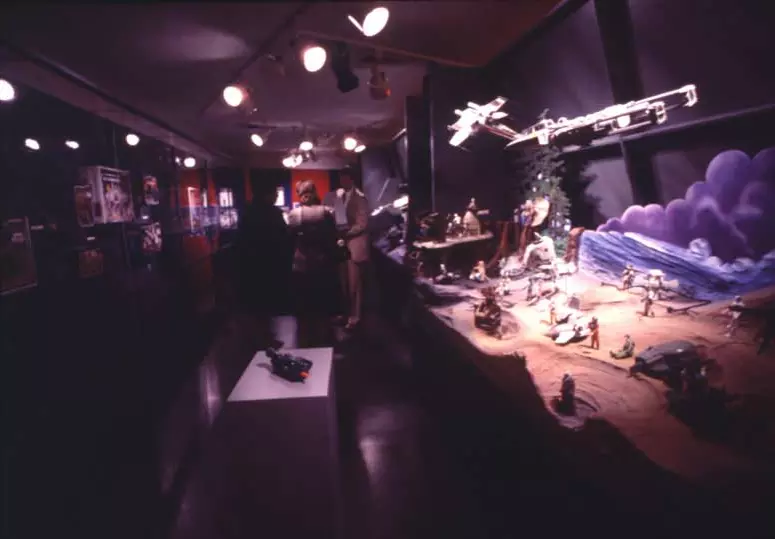
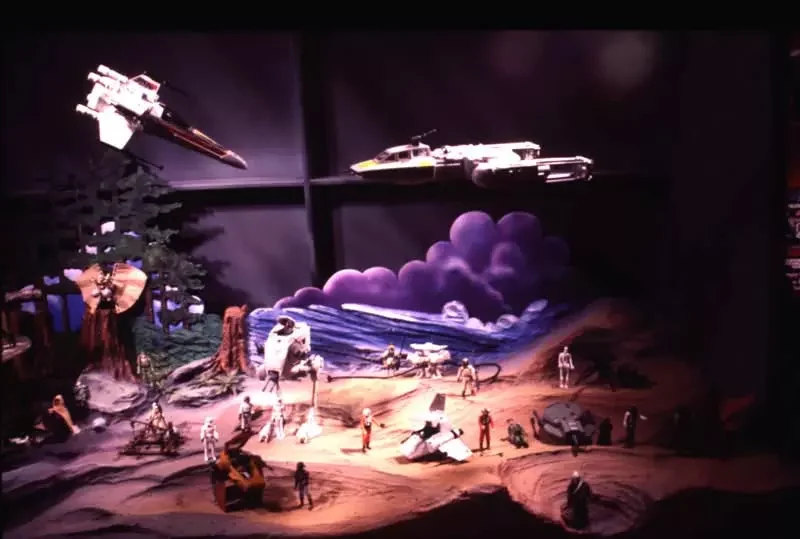
Diorama Principal: De Tatooine a Endor
El diorama principal de 1984 fusionó dos de los escenarios más icónicos de la trilogía:
- Tatooine con su árido paisaje y naves como el X-Wing y el Y-Wing en acción, junto con nuevos mini-rigs.
- Endor, hogar de los Ewoks, representado con el playset de la Ewok Village y elementos de bosque, también junto a nuevos mini-rigs.
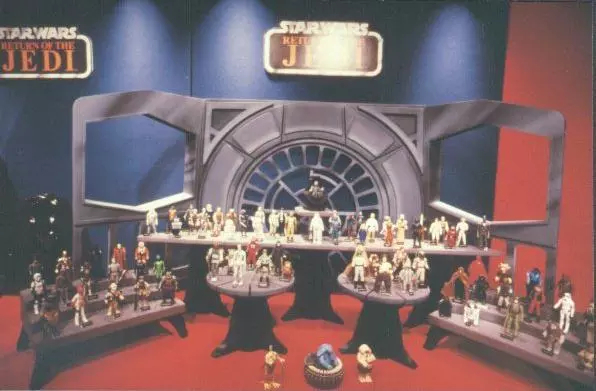
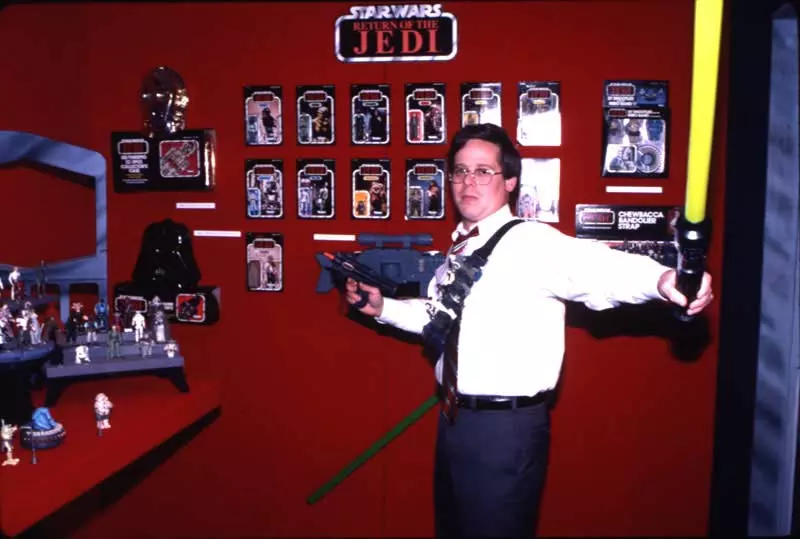
Kenner utilizó fondos recortados para darle dimensión a la escena, haciendo que la exhibición se sintiera como una auténtica recreación de lo experimentado en la película. Frente al diorama, una mesa exhibía el debut de la Biker Scout Laser Pistol, destacándola como uno de los lanzamientos del año. En una pared adyacente se encontraban muestras de los empaques de los juguetes de ROTJ, con algunas naves colgadas para darles un efecto dinámico.
El Trono del Emperador
Si el diorama de Hoth de 1981 había sido impresionante, el Trono del Emperador en 1984 elevó el nivel a otro nivel.
Inspirado en la sala del trono visto en la segunda Estrella de la Muerte del Return of the Jedi, este diorama presentaba al emperador en total plenitud sobre un trono que nunca salió a la venta, sólo se exhibió en esta feria y no existen registros que haya habido intención de que pasara a ser algo productivo en el futuro. El trono del Emperador que aparece en estas fotos terminó en una colección privada, después de ser adquirido a un ex vendedor de Kenner que trabajó en la Toy Fair.
Es interesante cómo se le entrega total protagonismo al Emperador, siendo este el que “presenta” todas las figuras disponibles de la colección hasta ese momento, no habiendo nada igual en las presentaciones previas. Además de exponer los cases de Vader, 3PO, blaster, la bandolera de Chewbacca, así como la Synootles and Max Reebo Band y mucho más.
Los letreros que se aprecian colocados en la pared detrás del diorama, también llegaron a manos de coleccionistas, convirtiéndose en piezas únicas de la historia de Kenner.
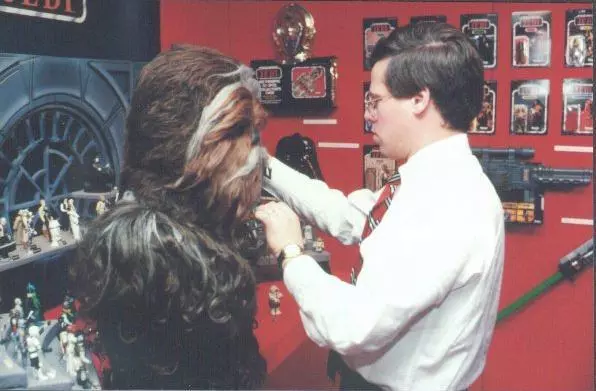
En una de las fotos del showroom, un vendedor aparece completamente equipado con productos de Star Wars, listo para la acción. ¿Un actor contratado? ¿Un fanático apasionado? No lo sabemos, pero su entusiasmo definitivamente aportó al espectáculo. Ese mismo vendedor aparece retocando un busto de Chewbacca entre visitas, que por lo visto estaba posicionada en otro lugar del showroom. Esa máscara no parece ser una don Post por sus colores y además que abarca más que la cabeza. Esto más parece una forma de decorar en el showroom, así como se hizo con el R2-D2 en la Toy Fair de 1978.
El Bosque de Peluches Ewoks
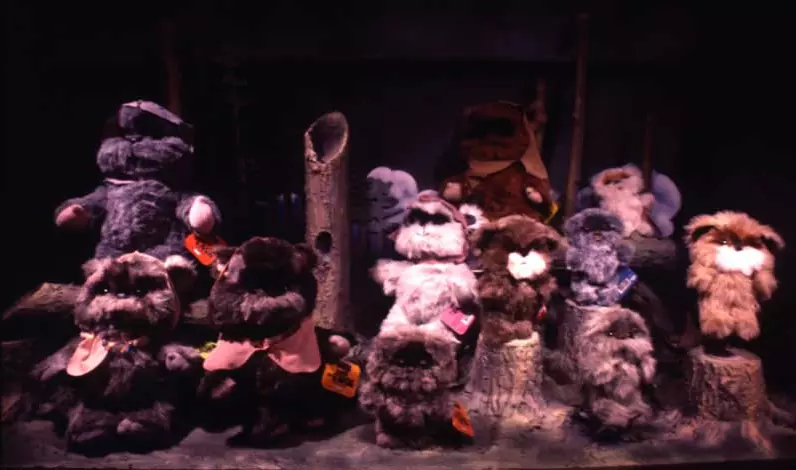
Kenner dedicó un área exclusiva para sus peluches de Ewoks y Woklings, en un entorno boscoso. Aunque no todos los fans adoraban a los Ewoks, si estos causaron gran sensación en los niños (por algo lanzaron tantos figuras de personajes Ewoks) y realizaron un trabajo de escenografía notable.
El Escuadrón de Naves de 1984
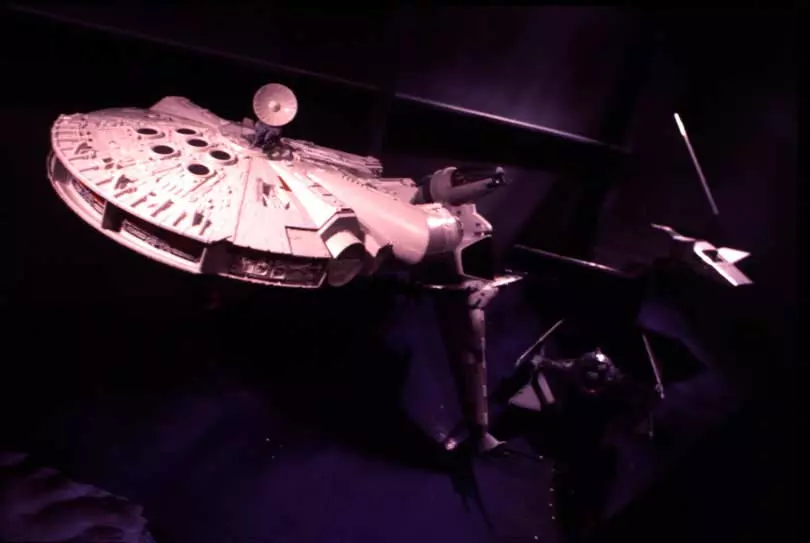
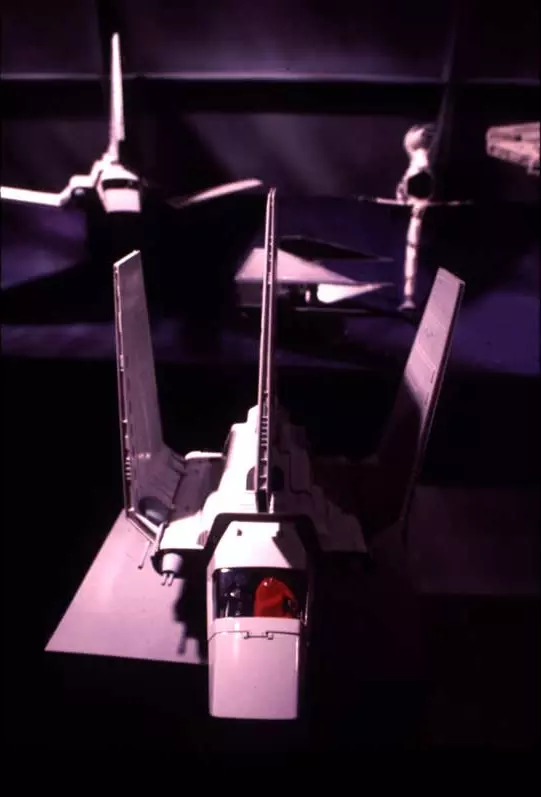
Arriba del diorama principal se aprecia un X-Wing y una Y-Wing sobrevolando Endor y Taooine respectivamente. A un costado de este diorama era posible encontrarse con una de las exhibiciones más impactantes de la Toy Fair, dada las naves que ahí se encontraban:
- Millennium Falcon
- B-Wing Fighter (lanzamiento de 1984)
- TIE Interceptor (novedad del año)
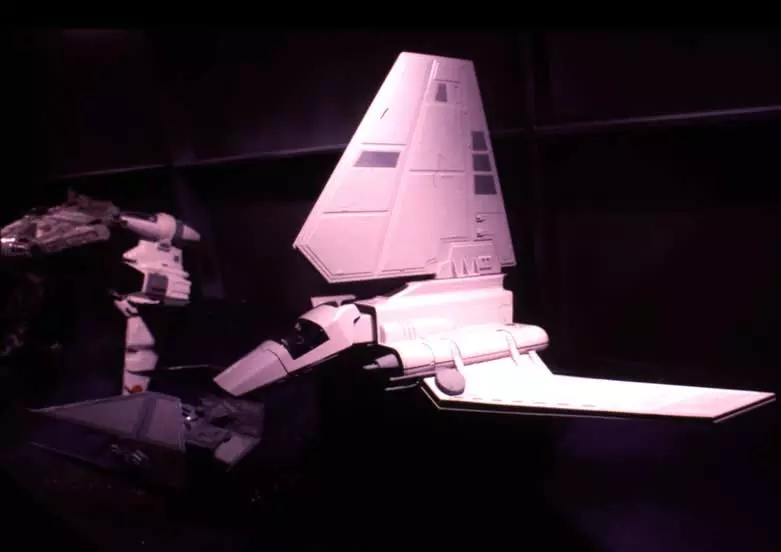
- Imperial Shuttle (una de las más esperadas por los fans). Por si fuera poco, además de estar colgada volando, un modelo de demostración de la Shuttle Tydirium estaba en exhibición, pilotada por un Royal Guard.
Vendedores, Compradores y Estrategias de Venta
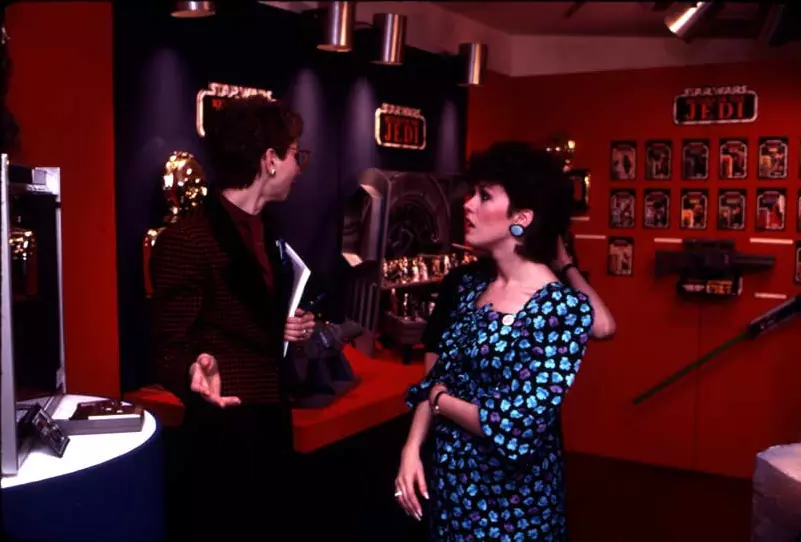
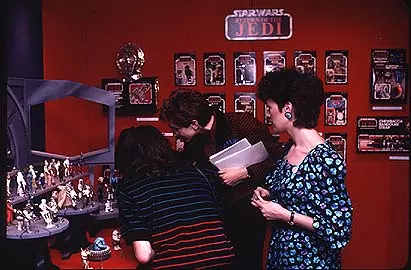
Como en cada Toy Fair, los vendedores de Kenner estaban en modo demostración máxima, convenciendo a los compradores de que Star Wars seguía siendo la mejor inversión. Las figuras y vehículos eran explicados en detalle, con énfasis en sus funciones y posibilidades de juego.
A medida que el hype de Return of the Jedi comenzaba a desvanecerse y la línea de juguetes de Kenner se acercaba a su fin en 1985, la Toy Fair de 1984 fue la última gran exhibición de Star Wars en su época dorada, donde se pudieron evidenciar dioramas más ambiciosos que nunca, naves colgadas simulando su vuelo y una Sala del Trono icónica, con lo que se buscaba evidenciar que Star Wars seguía fuerte en el mercado.
Aunque las ventas comenzarían a bajar en los años siguientes, esta Toy Fair fue un testimonio del impacto de Star Wars en la industria del juguete, dejando un legado de juguetes que marcaron a varias generaciones.
1985: Las Monedas de Toy Fair y el Último Intento de Kenner por Revivir Star Wars
Para 1985, la fiebre de Star Wars comenzaba a desvanecerse en el mundo de los juguetes. Sin embargo, Kenner aún tenía un as bajo la manga para tratar de mantener la línea en el mercado: las figuras con monedas conmemorativas de la colección Power of the Force (POTF), Droids y Ewoks.
En la Toy Fair de Nueva York de 1985, la compañía presentó una serie de mock-ups gigantes de monedas como parte de su estrategia de ventas para atraer compradores mayoristas. Estas piezas no sólo eran exageradamente grandes (midiendo varios centímetros de diámetro), sino que también mostraban un nivel de detalle impresionante, destacando la artesanía con la que Kenner diseñaba sus exhibiciones.
Estas enormes monedas siguen siendo testigos de un momento clave en la historia del coleccionismo, representando el último esfuerzo de Kenner antes del “apagón” de Star Wars en los juguetes hasta su resurgimiento a finales de los 90 y que no ha parado luego de casi 30 años.
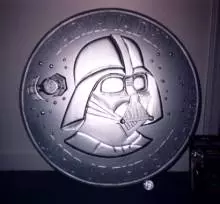
El Prototipo de la Moneda de Darth Vader (POTF)
Si hablamos de piezas únicas y espectaculares, la moneda gigante de Darth Vader es una de las más impactantes.
- Esculpida en 3D, replicando los detalles de la moneda real, incluidas las pequeñas estrellas de fondo.
- Pintura plateada metálica uniforme, dándole un acabado premium.
- Usada exclusivamente en la Toy Fair de 1985.
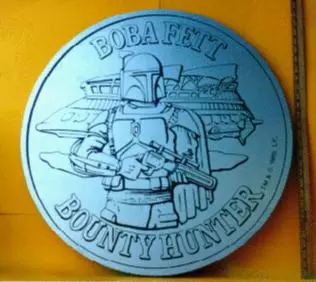
Mientras que otras monedas gigantes de la exhibición (como las de Boba Fett, Thall Joben y Logray) eran impresas sobre un fondo plano, la moneda de Vader era tridimensional, lo que la convertía en una de las piezas de exhibición más impresionantes que Kenner jamás produjo. Esta pieza es tan rara que hoy en día es prácticamente inubicable, a diferencia de algunos otros displays de Toy Fair que han terminado en colecciones privadas.
Moneda Gigante de Boba Fett (POTF)
La moneda de Boba Fett es otra de las joyas de esta exhibición.
- Tamaño colosal, como se puede ver comparándola con una regla en la foto.
- Exactamente el mismo arte utilizado en las monedas de POTF y Droids.
- Uno de los pocos prototipos supervivientes de esta campaña de Toy Fair.
Lo más curioso es que no está claro cómo clasificar esta pieza. ¿Es un prototipo de exhibición? ¿Un modelo de producción que nunca salió? ¿Un display de tienda? Sea lo que sea, es un objeto único y de gran importancia en la historia del coleccionismo de Kenner.
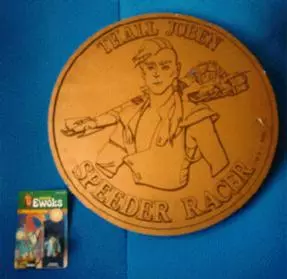
Moneda Gigante de Thall Joben (Droids)
Para promocionar la línea de Droids, Kenner presentó una moneda de gran tamaño con la imagen de Thall Joben, el protagonista de la serie animada. Esta pieza tenía un color bronce a diferencia con la que salió finalmente en producción. A pesar del esfuerzo de Kenner por hacer que Droids fuera un éxito, la serie y su línea de juguetes no lograron enganchar al público, convirtiendo estos artículos en curiosidades del universo coleccionista de Star Wars.
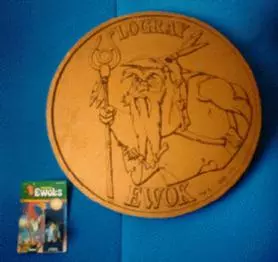
Moneda Gigante de Logray (Ewoks)
Para la serie Ewoks, se presentó una moneda similar a la de Droids, esta vez con el chamán Logray. También se exhibió en un tamaño muy grande, sólo que su color si fue idéntico al de producción. Al igual que Droids, la línea de Ewoks no tuvo el impacto esperado, lo que convierte estos artículos en rarezas difíciles de encontrar hoy en día.
What these articles examine is a true treasure for any Star Wars collector. They are some of the only existing images of Kenner’s showrooms at the early‑80s Toy Fairs, with photographs belonging to the collections of Todd Chamberlain, Chris Georgoulias, Ron Salvatore, John Kellerman, Gus López, and Will Grief — all from Gus López’s great site, The Star Wars Collectors Archive.
1981: Kenner’s Expansion and the Epic Star Wars Dioramas
For the 1981 Toy Fair, Kenner went all‑in on immersing visitors in the Star Wars universe, building three spectacular dioramas inspired by The Empire Strikes Back:
- Dagobah : the land of Yoda and Luke’s Jedi training.
- Hoth : the legendary battle between the Rebel Alliance and the Empire.
- Bespin : Lando’s floating city and the iconic duel between Vader and Luke.
These dioramas not only showcased the figures and vehicles in their natural environments, but also offered a level of detail never before seen at a Toy Fair, with fog effects, realistic textures, and hand‑painted backdrops.
Dagobah: Yoda’s World in Miniature
Kenner spared no detail in recreating Dagobah in its showroom. With a painted backdrop of twisted trees and artificial fog made from foam or cotton, the Dagobah Playset stole the spotlight thanks to its three‑dimensional roots and its levitation feature for Luke’s Force training. The diorama also incorporated the TIE Fighter and the X‑Wing. The X‑Wing box featured new artwork based on Dagobah.
Hoth: The War on the Frozen Battlefield
The Hoth diorama was one of the most impressive parts of the showroom, with a huge area dedicated to the most famous battle of The Empire Strikes Back (and of the entire saga). It featured a hand‑painted snowy backdrop and manually applied “snow” effects, and included the following toys:
- Imperial Attack Base
- Turret and Probot Playset
- AT‑AT Walker
- Snowspeeder
- Mini‑Rigs – Various versions of this new concept, showing how Kenner expanded the Star Wars universe with original, never‑seen‑before vehicles.
Bespin: The City in the Clouds and the Slave I
The Bespin diorama, although less documented than the other two, demonstrated Kenner’s ability to recreate iconic scenes with remarkable detail. It seems to be less documented because, comparatively, it appears a bit more modest in scale.
Arrival at Cloud City
- The landing platform where Lando greets Han and Leia was meticulously represented.
- Interestingly, instead of using the Leia in her Bespin gown figure, the designer opted for the version with the Hoth outfit, a detail that reflected strong fidelity to the film’s chronology . Remember that the Leia Bespin figure was released in the fourth wave, while Leia Hoth appeared in the sixth wave.
- A visual trick extended the landing platform through a painted background, giving the scene added depth — a technique widely used in filmmaking.
Slave I and Boba Fett
- The Slave I was displayed surrounded by figures, creating a scene worthy of Han Solo’s capture.
- As with the previous diorama, the depth effects in the painted background added realism to the floating city.
The Action‑Figure Diorama and the Mail‑Away Promotions
As in previous years, Kenner showcased its figures in a special display — this time featuring a mountain‑style presentation behind a glass panel, surrounded by carded figures with the 1981 mail‑away offers:
- Display Arena – Four exclusive stands for arranging figures, each with different themes inspired by the films.
- Survival Kit – The year’s mail‑away accessory set, including backpacks, weapons, and tools to enhance the figures.
The Empire Strikes Back logo floated above the display, reinforcing the identity of the line. Both promotions were also showcased separately within the showroom.
Vehicles, Accessories, and Showroom Curiosities
Among other standout displays, the showroom featured:
- Slave I – Although part of the Bespin diorama, it also had its own dedicated display.
- The Legendary AT‑AT – It also had its own showcase, complete with TV commercials playing behind it.
- Turret & Probot Playset – Featuring C‑3PO, who appears to have grabbed a blaster from the turret (a surprisingly rebellious moment!).
- Die‑Cast Vehicles – Displayed alongside the Darth Vader carrying case and Empire vinyl cases.
- Yoda Handpuppet – A vinyl puppet that allowed kids to bring the wise Jedi Master to life.
- Yoda the Jedi Master “Magic 8‑Ball” – A fortune‑telling toy based on Yoda, a true rarity within the Star Wars line.
- The “Star Wars is Forever” Retail Display – A slogan Kenner would use for years to reinforce the franchise’s lasting impact (and they were absolutely right).
With stunning dioramas, an increasingly varied product offering, and a more aggressive commercial strategy, Kenner made it clear at the 1981 Toy Fair that Star Wars was no longer just a toy line — it had become an entire universe children could explore and collect.
For today’s collectors, this exhibition represents a milestone in the evolution of the franchise, the moment when Kenner stopped simply selling figures and began recreating the galaxy in every detail.
And you — if you had been there, which piece would you have grabbed without hesitation?
1982: Another Giant Enters the Scene
In 1982, the toy market experienced significant changes with the introduction of new lines that impacted the popularity of existing products such as Kenner’s Star Wars toys. According to Battle Ram Blog, the Masters of the Universe (MOTU) line by Mattel was presented to the public for the first time on February 17, 1982, during the New York Toy Fair. This event was crucial, marking the official debut of He‑Man and his universe, introducing the characters and products that would define the line.
The blog highlights that although some celebrate October 12, 1982, as He‑Man’s anniversary, evidence suggests that the MOTU line was already available in stores by May 1982. A rebate offer printed in the first mini‑comics indicates that the figures may have been on shelves as early as March 1, 1982.
MOTU quickly gained popularity and became a major competitor in the action‑figure market. The arrival of He‑Man represented direct competition for established lines, including Kenner’s Star Wars. Although Star Wars toys remained popular, the emergence of successful new lines like He‑Man diversified consumer options and likely affected Star Wars’ market share during that period.
In the Austin American‑Statesman newspaper article dated December 1, 1982, the toy war between Kenner, Hasbro, and Mattel is described as a recurring conflict within the toy industry, intensifying during the holiday shopping season. The article notes that the battles between these companies reignited around Thanksgiving, with aggressive advertising strategies aimed at children aged 5 to 11.
Kenner is highlighted as the producer of the Star Wars action figures, including characters such as R2‑D2, Luke Skywalker, Leia Organa, Darth Vader, and Yoda. Interestingly, that same year the action‑figure line expanded with additional characters, including updated versions of R2‑D2 (Sensorscope) and C‑3PO (Removable Limbs), as well as new additions such as Luke Skywalker in Hoth Battle Gear, the AT‑AT Commander, the Cloud Car Pilot, the Bespin Security Guard, along with 4‑LOM, Zuckuss, and the Imperial TIE Fighter Pilot.
The article also mentions that Star Wars products ranked among the five best‑selling toys, alongside other popular lines of the era such as Strawberry Shortcake (Kenner), Barbie (Mattel), E.T. (various manufacturers), and Masters of the Universe (Mattel). Finally, it refers to He‑Man and the Masters of the Universe as an emerging competitor, suggesting it was a “copy” of the Star Wars concept but blended with the fantasy of Dungeons & Dragons.
Despite adding interesting items to the collection, 1982 was perhaps a somewhat modest year for Kenner in terms of exciting new offerings, resulting in a smaller presence at that year’s Toy Fair and giving the spotlight to new competitors.
1983: Coexisting with E.T.
Despite the massive impact of E.T. the Extra‑Terrestrial on the entertainment industry and its overwhelming success in the toy market with hundreds of licensed products, Star Wars remained present on the scene — though with more modest sales compared to previous years. While E.T. products, such as Kamar International’s plush dolls, dominated holiday sales, the Star Wars franchise, driven by Kenner, maintained its place at the Toy Fair but without the explosive momentum of earlier years.
The arrival of E.T. coincided with a shift in toy‑market trends, where strong licensed products — such as Strawberry Shortcake and The Smurfs — remained solid, but Star Wars sales reflected a natural decline after years of dominance. This shift was also influenced by the rise of video games, especially the growing popularity of Atari and competing systems like Colecovision and Vectrex.
While E.T. became a sales phenomenon, Star Wars toys worked to maintain relevance in an increasingly competitive environment. That year’s Toy Fair showcased this transformation in the industry, with the presence of revitalized classics like G.I. Joe, as well as expanding military and sci‑fi lines. The challenge for Kenner and Star Wars was clear: adapt to a constantly evolving market where the E.T. phenomenon set a new standard for licensed toy marketing.
1984: Kenner’s Last Great Star Wars Showroom
By 1984, Star Wars had already become a pillar of the toy industry, and Kenner dominated the Toy Fair with increasingly ambitious presentations. This year was no exception: with Return of the Jedi still fresh in fans’ minds, Kenner’s exhibition was one of its most spectacular yet, featuring detailed dioramas, new vehicles, and a throne room worthy of the Emperor.
Main Diorama: From Tatooine to Endor
The main 1984 diorama merged two of the trilogy’s most iconic settings:
- Tatooine with its arid landscape and ships like the X‑Wing and Y‑Wing in action, along with new mini‑rigs.
- Endor — home of the Ewoks — represented with the Ewok Village playset and forest elements, also accompanied by new mini‑rigs.
Kenner used cut‑out backdrops to give the scene depth, making the display feel like a true recreation of the film’s environments. In front of the diorama, a table showcased the debut of the Biker Scout Laser Pistol, highlighting it as one of the year’s major releases. On an adjacent wall, samples of ROTJ toy packaging were displayed, with several ships hung to create a dynamic, airborne effect.
The Emperor’s Throne
If the 1981 Hoth diorama had been impressive, the Emperor’s Throne in 1984 took things to an entirely new level.
Inspired by the throne room seen aboard the second Death Star in Return of the Jedi, this diorama presented the Emperor in full splendor, seated on a throne that never made it to retail. It was created exclusively for the Toy Fair, and there are no records suggesting it was ever intended for production. The throne featured in these photos eventually ended up in a private collection, after being acquired from a former Kenner salesman who worked at the event.
It’s fascinating how the display gave complete prominence to the Emperor, who “presented” all the figures available in the line up to that moment — something never seen in previous showcases. The display also included the Vader, 3PO, and blaster cases, the Chewbacca Bandolier Strap, the Sy Snootles & Max Rebo Band, and much more.
The signs displayed on the wall behind the diorama also found their way into collectors’ hands, becoming unique pieces of Kenner history.
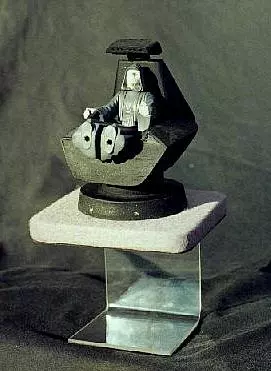
In one of the showroom photos, a salesman appears fully equipped with Star Wars products, ready for action. Was he a hired actor? A passionate fan? We don’t know — but his enthusiasm certainly added to the spectacle. The same salesman appears touching up a Chewbacca bust between visits, which seems to have been positioned elsewhere in the showroom. That mask doesn’t resemble a Don Post piece due to its colors and the fact that it covers more than just the head. It looks more like a decorative element created specifically for the showroom, similar to how R2‑D2 was used in the 1978 Toy Fair.
The Ewok Plush Forest
Kenner dedicated an exclusive area to its plush Ewoks and Woklings, arranged within a charming forest‑themed environment. Although not every fan adored the Ewoks, they caused a huge sensation among children (there’s a reason so many Ewok characters were released), and Kenner delivered a notably well‑crafted scenic display.
The 1984 Starship Squadron
Above the main diorama, an X‑Wing and a Y‑Wing can be seen flying over Endor and Tatooine respectively. To the side of this diorama, visitors encountered one of the most striking displays of the Toy Fair, thanks to the ships showcased there:
- Millennium Falcon
- B‑Wing Fighter (released in 1984)
- TIE Interceptor (new for the year)
- Imperial Shuttle (one of the most anticipated ships by fans). As if that weren’t enough, in addition to being displayed hanging in flight, a demonstration model of the Shuttle Tydirium was showcased, piloted by a Royal Guard .
Sellers, Buyers, and Sales Strategies
As in every Toy Fair, Kenner’s sales representatives were in full demonstration mode, convincing buyers that Star Wars remained the best investment in the market. Figures and vehicles were explained in detail, with strong emphasis on their features, play value, and the imaginative possibilities they offered.
As the Return of the Jedi hype began to fade and Kenner’s Star Wars line approached its end in 1985, the 1984 Toy Fair stood as the last great Star Wars showcase of its golden era, featuring more ambitious dioramas than ever, ships suspended in mid‑flight, and an iconic Throne Room — all designed to show that Star Wars was still a strong force in the market.
Although sales would decline in the following years, this Toy Fair was a testament to the impact of Star Wars on the toy industry, leaving behind a legacy of toys that shaped multiple generations.
1985: The Toy Fair Coins and Kenner’s Final Attempt to Revive Star Wars
By 1985, the Star Wars craze had begun to fade in the toy world. However, Kenner still had one last trick up its sleeve to keep the line alive: the commemorative coin figures from the Power of the Force (POTF), Droids, and Ewoks collections.
At the 1985 New York Toy Fair, the company unveiled a series of giant coin mock‑ups as part of its sales strategy to attract wholesale buyers. These pieces were not only exaggeratedly large (measuring several centimeters in diameter), but also displayed impressive detail, showcasing the craftsmanship Kenner put into its exhibits.
These oversized coins remain key witnesses of a pivotal moment in collecting history, representing Kenner’s final effort before the “dark period” of Star Wars toys, which lasted until the franchise’s revival in the late ’90s — a resurgence that has continued for nearly 30 years.
The Darth Vader Coin Prototype (POTF)
When it comes to unique and spectacular pieces, the giant Darth Vader coin is one of the most striking.
- 3D sculpted , replicating the details of the real coin, including the tiny background stars.
- Metallic silver paint with a uniform finish, giving it a premium look.
- Used exclusively at the 1985 Toy Fair .
While other giant coins in the exhibit (such as those of Boba Fett, Thall Joben, and Logray) were printed on flat backgrounds, the Vader coin was fully three‑dimensional, making it one of the most impressive display pieces Kenner ever produced. This item is so rare that today it is virtually untraceable, unlike some other Toy Fair displays that have ended up in private collections.
Giant Boba Fett Coin (POTF)
The Boba Fett coin is another standout jewel from this exhibition.
- Colossal size — clearly visible when compared to a ruler in the photo.
- Exactly the same artwork used on the POTF and Droids coins.
- One of the few surviving prototypes from this Toy Fair campaign .
The most curious aspect is that its classification remains unclear. Is it a display prototype? A production model that never made it to retail? A store display piece? Whatever its intended purpose, it stands as a unique and highly significant artifact in Kenner’s collecting history.
Giant Thall Joben Coin (Droids)
To promote the Droids line, Kenner introduced a large‑format coin featuring Thall Joben, the protagonist of the animated series. This piece had a bronze‑like color, noticeably different from the version that eventually reached production. Despite Kenner’s efforts to make Droids a success, both the show and its toy line failed to capture the public’s interest, turning these items into curiosities within the Star Wars collecting universe.
Giant Logray Coin (Ewoks)
For the Ewoks series, Kenner introduced a giant coin similar to the one created for Droids, this time featuring the shaman Logray. It was also displayed in an oversized format, though its color matched the production version exactly, unlike the bronze‑toned Thall Joben coin.
Just like the Droids line, the Ewoks collection did not achieve the expected impact, turning these oversized display coins into rare and highly sought‑after collectibles that are difficult to find today.